

Backend Security Basics: Authentication, Authorization, and API Protection

Dhwanit P.

Jan 02, 2026

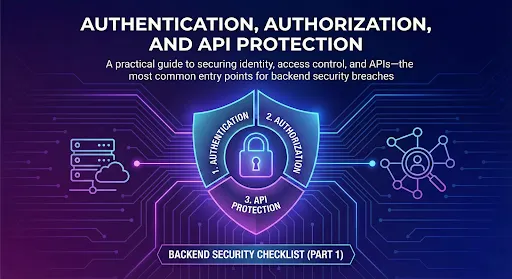
When people think about security breaches, they often imagine complex exploits or highly sophisticated attacks. In reality, most backend breaches start with something far more basic: weak authentication, broken authorization, or poorly protected APIs.
Backend systems sit at the heart of modern applications. They handle identity, permissions, APIs, databases, and sensitive business logic. As teams move toward cloud infrastructure, microservices, and API-first designs, the backend has become the most attractive target for attackers.
Frontend issues are easy to notice. Backend issues often remain invisible — until private data is leaked or systems are compromised.
This article is Part 1 of a practical backend security checklist, focused on the first and most critical layer of defense: authentication, authorization, and API security. If these foundations are weak, no amount of encryption or monitoring will save the system.
Why Backend Security Needs a Checklist
Most backend security failures don’t happen because teams don’t care about security. They happen because basic practices were skipped, assumed, or applied inconsistently.
Common reasons include:
- Default configurations left unchanged
- Missing or inconsistent authorization checks
- Blind trust in “internal” services
- No structured security review before deployment
A checklist doesn’t replace security expertise — but it prevents obvious mistakes. It ensures critical controls are reviewed every time, regardless of deadlines, team size, or project complexity.
1. Authentication: Securely Verify User Identity
Authentication answers a simple question: Who is this user?
If the system gets this wrong, every protected resource is exposed.
Checklist
1. Hash passwords using bcrypt, scrypt, or Argon2
Passwords should never be stored as plain text. Hashing algorithms like bcrypt, scrypt, and Argon2 are designed to be slow and resistant to brute-force attacks, making stolen password databases much harder to exploit.
2. Never store plaintext credentials
If an attacker gains database access and passwords are stored in plaintext, every user account is instantly compromised. Hashing ensures that even if data leaks, passwords are not directly usable.
3. Enable multi-factor authentication (MFA) where possible
- MFA adds an extra verification step (such as a one-time code or authenticator app). Even if a password is stolen, MFA can prevent unauthorized access.
4. Use token-based authentication (JWT or OAuth 2.0)
- Instead of sending credentials with every request, token-based systems issue a temporary token after login. This reduces credential exposure and works well with APIs and distributed systems.
5. Apply proper token expiration and refresh policies
Tokens should expire after a reasonable time to limit damage if they are leaked. Refresh tokens allow users to stay logged in securely without issuing long-lived access tokens.
Even a single insecure login path can render every downstream control useless.
2. Authorization: Control What Users Can Access
If authentication answers who, authorization answers what.
This is where many real-world breaches occur.
Checklist
1. Implement role-based access control (RBAC)
RBAC assigns permissions based on roles (e.g., admin, user, manager) rather than individuals. This simplifies access management and reduces the risk of accidental over-permissioning.
- Example: Only users with the
adminrole can access/admin/users, while regular users cannot.
2. Follow the principle of least privilege
Users and services should only have access to what they absolutely need — nothing more. This limits the impact of compromised accounts or bugs.
Example: A reporting service can read data but cannot delete or modify records.
3. Validate permissions on every sensitive endpoint
Every backend endpoint that accesses or modifies sensitive data must check permissions explicitly. Skipping checks in “trusted” endpoints is a common source of breaches.
Example: The backend verifies ownership before allowing a user to update /users/{id}.
4. Never rely on frontend checks for authorization
Frontend logic can be bypassed easily. All authorization decisions must be enforced on the backend, regardless of what the UI allows or hides.
Example: Even if the “Delete” button is hidden, the backend still blocks unauthorized delete requests.
5. Identify and block privilege-escalation paths
Ensure users cannot modify roles, permissions, or identifiers in a way that grants them higher access than intended — intentionally or accidentally.
Example: A user cannot change their own role from user to admin via an API request.
3. API Security: Defend the Most Exposed Layer
APIs are often the most visible — and most attacked — part of backend systems.
They deserve extra attention.
Checklist
1. Require authentication for all non-public APIs
Any API that accesses user data or internal systems should require authentication. Public access should be the exception, not the default.
Example: Requests to /api/orders are rejected if no valid access token is provided.
2. Strictly validate request payloads
APIs should validate data types, formats, and allowed values. This prevents malformed requests, injection attacks, and unexpected behavior.
Example: An API rejects an order request if the quantity is negative or missing.
3. Avoid exposing unnecessary fields in responses
Only return data that clients actually need. Extra fields can leak sensitive information or provide attackers with valuable system details.
Example: A user profile response excludes internal IDs and password metadata.
4. Apply rate limiting and request throttling
Rate limits prevent abuse such as brute-force attacks or denial-of-service attempts by restricting how frequently an API can be called.
- Example: Login attempts are limited to 5 requests per minute per IP address.
5. Handle errors without leaking internal details
Error messages should be helpful but generic. Exposing stack traces, database errors, or internal identifiers can give attackers insight into system internals.
- Example: The API returns “Invalid request” instead of a full database error message.
APIs are not just interfaces — they are security boundaries.
Conclusion: Secure the Foundations First
Most backend security incidents begin in the same places: weak authentication, broken authorization, or poorly protected APIs.
These layers define the security perimeter of your system. When they fail, every other security measure becomes irrelevant.
By strengthening identity verification, enforcing access control correctly, and hardening APIs, developers can eliminate the most common attack paths before attackers reach deeper parts of the system.
Security doesn’t start with advanced tooling — it starts with getting the basics right.
Continue Reading
This article covered the first line of backend defense: authentication, authorization, and API protection.
In Part 2, we’ll dive into:
- Data protection
- Secure configuration
- Monitoring and logging
- Secure development and operational practices