

Backend Security Basics (Part 2): Data Protection, Configuration, and Secure Operations

Dhwanit P.

Jan 09, 2026
:%20Data%20Protection,%20Configuration,%20and%20Secure%20Operations)
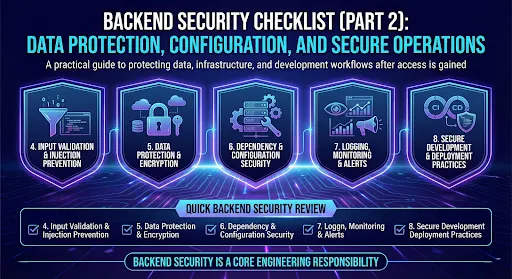
Strong authentication and API security can stop many attacks — but not all of them.
In real-world breaches, attackers often gain some level of access and then succeed because of weak data handling, exposed secrets, insecure configurations, or missing monitoring. These are the failures that turn a small incident into a large-scale data breach.
Backend security doesn’t end at login screens or access checks. It continues through how data is handled, how systems are configured, and how teams operate software in production.
This article is Part 2 of the Backend Security Checklist, focusing on post-access security — the controls that determine whether an attacker is contained quickly or allowed to move freely inside your system.
Before You Start
This article builds on the foundations covered in Part 1, which focuses on:
- Authentication
- Authorization
- API protection
Together, these form the first line of defense for backend systems.
1. Input Validation and Injection Prevention
Unvalidated input remains one of the most reliable and widely exploited attack vectors in backend systems.
Checklist
1. Validate all inputs (body, params, headers, query)
Ensure every input matches expected types, formats, and ranges.
Example: Reject a request if age is a string instead of a number.
2. Prevent SQL and NoSQL injection
- Use parameterized queries and avoid string-building database queries.
Example: Use prepared statements instead of concatenating user input into SQL.
3. Sanitize user-generated content
- Remove or escape unsafe characters before storing or rendering content.
Example: Strip<script>tags from user-submitted comments.
4. Use ORM or query builders safely
- Leverage ORM protections but avoid raw queries unless absolutely necessary.
Example: Use ORM filters instead of writing rawWHEREclauses with user input.
5. Never trust client-supplied data
Assume all incoming data can be manipulated, even from authenticated users.
Example: Verify the user ID from the token instead of trusting the ID sent in the request body.
Every external input should be treated as potentially malicious.
Even trusted users and internal services can send malformed or dangerous input — intentionally or not.
2. Data Protection and Encryption
Sensitive data must be protected throughout its entire lifecycle — from transmission to storage to access.
Checklist
- Enforce HTTPS using TLS for all traffic
- Encrypt sensitive data at rest
- Secure API keys, tokens, and credentials
- Avoid hard-coded secrets
- Use environment variables or secret managers
Many data breaches happen because secrets were exposed — not because encryption was broken.
Poor secret handling is one of the most common and preventable security failures.
3. Dependency and Configuration Security
Secure application code can still be compromised by insecure runtime environments.
Checklist
- Keep frameworks and libraries up to date
- Monitor dependencies for known vulnerabilities
- Disable unused services and open ports
- Apply secure default configurations
- Separate development, staging, and production environments
Configuration mistakes are among the most common real-world causes of breaches.
Most attackers don’t need zero-day exploits — misconfigurations are often enough.
4. Logging, Monitoring, and Alerts
Without visibility, security incidents often go unnoticed until damage is already done.
Checklist
- Log authentication and authorization failures
- Monitor abnormal request patterns
- Track access to sensitive resources
- Set alerts for suspicious behavior
- Avoid logging sensitive data
You can’t respond to threats you can’t see.
5. Secure Development and Deployment Practices
Security should be built into the development lifecycle — not added as a final step before release.
Checklist
1. Conduct security-focused code reviews
Review changes with security risks in mind, not just functionality.
- Example: Flag a PR that introduces a new endpoint without authorization checks.
2. Integrate security checks into CI/CD pipelines
Automate security scanning so issues are caught early.
Example: Block deployment if a dependency scan detects a critical vulnerability.
3. Perform vulnerability scanning regularly
Continuously scan applications and infrastructure for known issues.
- Example: Run weekly scans to detect outdated libraries with known CVEs.
4. Run penetration tests before major releases
Simulate real-world attacks to identify exploitable weaknesses.
- Example: Hire a security team to test authorization and API abuse scenarios.
5. Document security assumptions and decisions
Record why certain security choices were made and what they depend on.
- Example: Document why an internal API is restricted to a private network.
Secure systems are the result of secure processes.
Strong security is not accidental — it’s operational discipline.
Quick Backend Security Review
Before deploying to production, ask yourself:
- Is authentication strong and correctly implemented?
- Are permissions enforced on the backend?
- Are APIs validated, protected, and rate-limited?
- Is sensitive data encrypted and secrets secured?
- Are monitoring and alerts in place?
If any answer is no, the system is exposed.
Conclusion: Security Is What Happens After Access
Backend security isn’t about implementing every possible defense. It’s about consistently applying proven fundamentals across code, configuration, and operations.
Most breaches don’t happen because systems are too complex. They happen because basic safeguards were skipped, assumed, or forgotten.
By protecting data, securing configurations, monitoring systems, and embedding security into development workflows, teams can prevent small weaknesses from escalating into major incidents.
In modern software development, secure backend design is a core engineering responsibility — not an optional enhancement.